2011
2011-09-28 - New diArk publication
We proudly present the new diArk paper. It describes the newest features of diArk and the available data. Furthermore, it compares diArk to related databases and explains, why you should use diArk.


2011-03-30 - New welcome page
diArk's welcome page has been revised. Now, the latest species in the database are shown together with information about the genome type, taxonomy, number of contigs, GC-content, size in Mbp, and the corresponding file size. Also a link is provided directing to the corresponding diArk species page for full information. Try it and visit http://www.diark.org.
2011-03-28 - New function: Sharing your search
Now it is possible to send the result of your search to colleagues and friends. To do that, click the ShareThis icon  , which is available in each result tab.
By clicking this icon, a small popup window will appear where you can select e.g. Email, Facebook, Twitter, or Google Buzz to send your search. Shared searches will be available on the server for three days.
, which is available in each result tab.
By clicking this icon, a small popup window will appear where you can select e.g. Email, Facebook, Twitter, or Google Buzz to send your search. Shared searches will be available on the server for three days.
2010
2010-09-07 - New functions and changes
This is a major update to the database scheme, the web-interface, and the database content. In the Projects search module, it is now possible to search for a reference using an autocompletion text field. In the Genome Files search module, different kind of sequencing methods can be searched for. Furthermore, search results can be filtered by different assembly methods and the corresponding software versions.
In the Projects result view, the work of the sequencing centers and the curators of species home pages is now referenced, if the corresponding work has been published. Of course, every work is still referenced by links to the corresponding webpages.
Many changes were made to the Genome_Files result view. Now, you can also download genomes that are not from NCBI if you accept the license for usage as written by the sequencing centers. You can recognize those files by the download icon with a key in it. Furthermore, you can get a graph with all contigs ordered by their length and the resulting N50 value. This information can be used to judge the quality of the dataset. More sequence information was added to the Seq info. The different sequencing methods are colour-coded, and further information like the types of clone-libraries, sequencing coverage, and methods used to create the assembly can be obtained by clicking on the icon.
In the Sequencing_Stats result view many new statistical analyses are available: all species separated by taxa, total sequenced species by taxa/year, complete and incomplete species/year, total available sequenced species/year (number of species and number of data), genomesize/GC-content (separated by taxa), boxplot of the genomesize of taxa, sequencing method/year, number of publications/year, and total assembled data/year for the major sequencing centres (number of genomes and number of bases). And like everything at diArk, these graphs are computed on-the-fly and only for the selection of your search (therefore it might sometimes take some time). And of course, you can download each of the graphs.
Furthermore, an additional way of searching diArk's data was developed, the so-called Fast_Search. Here, you can search diArk using the most common search options. This search would be most suitable for beginners.
2010-09-06 - New News System
A RSS-Feed is now available to obtain the latest news and changes about diark. The feed includes updates on newly sequenced species as well as new assemblies of already sequenced species. New cDNA/EST projects and publications will not be listed. To stay up-to-date we highly recommend to use diArk's RSS-Feed!
2009
2009-08-27 The new RSS-Feed is available
To subscribe to diArks RSS-Feed, just click on the RSS icon in the address bar of your browser. Here is an example for Firefox:

Subsequently you will be forwarded to the RSS page. To directly reach this page, you can also enter the url 'http://www.diark.org/diark/feed'
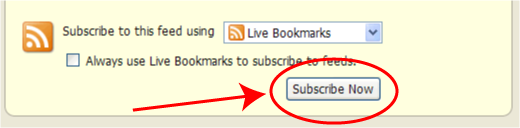
On top of the RSS page, click "Subscribe Now" and select a folder in your bookmarks where to save the link.
There is a nice plug-in for Firefox, called "Brief", which checks all your RSS links and displays the new entries.
Check it out. You can also use every RSS-Feed reader you want, to be up-to-date with diArk.
2009-01-28
A major update of diArk has been released. This includes a complete reorganisation of the result views (Genome Stats, Genome Files, References, Sequencing Stats) because of changes in the database schema. Now, all genome data is directly obtained from the corresponding genome-assembly files that we got from the sequencing centers and NCBI/EMBL/DDBJ. The new result views provide genome assembly related data, like the GC-content of the genomes, the number of contigs, the assembly coverage, the assembly versions, the release dates, and many more. In addition, we now provide all whole-genome assemblies (complete and incomplete genomes), that have been submitted to NCBI/EMBL/DDBJ, as downloads. Of course, this update also includes hundreds of new species, projects, and related publications.
2007
2007-7-20 Mozillas add-on bioFOX includes diArk search
Good news for users with the bioFOX add-on for mozilla/firefox. In the next release of bioFOX the diArk search option for species search will be included! If you don't know bioFOX yet, we recommend to have a look.
2007-07-01 Search plugin available!
Now search in diArk directly from your browser!
You can search for any species existing in the diArk. Just type in either the scientific name, the common name, the German name, or the taxonomy. The result will show all matches to your search, e.g. all mammals when searching for "Mammalia".

Either click on image above (Firefox only) or pull down the search menu at the top right corner of your browser window and select "add diArk species search" to install.
2007-07-01
Many new features have been included in an updated version of the web-interface. In addition, we have expanded the projects related data including information about sequence coverage, sequence version, BLAST/BLAT search possibilities. Also, many completed genomes can now directly be downloaded. There are several new search options as well as new results/analysis modules. In particular, the main changes are the following:
- The projects module has been extended to allow searching for the new projects meta data.
- Three new modules for the result section have been designed. One presents certain statistics based on the selected subset of species. Another, called "references", lists the project meta data sorted by species. The third module presents information about chromosome numbers and genome sizes. The genome data download has been integrated in the projects module.
- It is possible now to personalize diArk in certain aspects. Based on OpenID login users can save their search criteria or subscribe to our newsletter.
- Users can now install a diArk search-bar for their browser. This provides fast and easy access to diArk's species content.
2006
2006-12-13
We have updated the database. diArk now includes 415 species, 823 sequencing projects, and 248 publications. There is a Help page now that explains the use of diArk's search modules. We have also set up a list of FAQ's that will be extended as soon as further question rise.
2006-10-10
diArk goes online! We are proud to have finished all functionality-related programming, so we can launch the web-interface to diArk. Although we still discuss some functionality issues and we haven't included all data we consider to be useful, we feel it's time now to go public. The link list is far from being complete and we appologize to those we haven't mentioned yet. Version 1.0 is now available including 364 species, 742 sequencing projects, and 228 publications.